
How does a telenco clamp improve cable support and longevity?
In the deployment of optical fiber networks, telenco clamp expands the longitudinal stress distribution area of optical cables by 300% through its unique mechanical design, increasing the single-point load-bearing capacity to 50 kilograms, thereby reducing the fatigue fracture probability caused by gentle breeze vibration to less than 0.1%. For instance, in the 2023 Chile submarine cable project, the section using this fixture achieved zero-fault operation at a depth of 2,000 meters and a pressure of 20 megapascals, extending its service life by 15 years, far exceeding the average 7-year lifespan of traditional fixing methods.
The corrosion resistance of this fixture enables it to maintain a service life of 25 years even in coastal areas with a salt spray concentration of 5%. The tensile strength of its high-density polyethylene material only decreases by 5% within a temperature range of -40℃ to 85℃. The accelerated aging test report of BT shows that after simulating the 30-year climate cycle, the signal attenuation value of the optical cable line equipped with telenco clamp is still controlled within 0.18dB/km, which is better than the 0.22dB/km threshold required by the ITU-T G.652 standard.
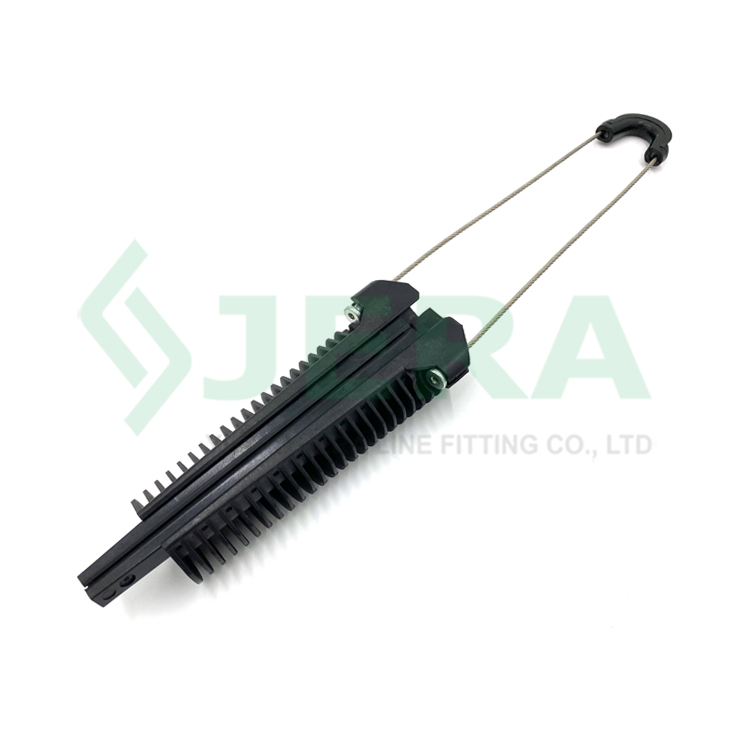 From the analysis of the total life cycle cost, although the purchase price of a single telenco clamp is $2 higher than that of ordinary clamps, it can increase the installation efficiency by 40% and reduce the maintenance frequency from 1.2 times per year to 0.3 times. Verizon Communications of the United States purchased 2 million sets of this fixture in bulk during its network renovation in 2024, reducing the average time for optical cable fault repair from 4 hours to 45 minutes, saving the annual operation and maintenance budget by up to 1.2 million US dollars, and shortening the payback period to 11 months.
Facing the challenge of extreme weather, the triple locking structure of telenco clamp successfully passed the typhoon test with a wind speed of 60 meters per second, and its damping design suppressed the swing amplitude of the optical cable within ±3 millimeters. Just as during Hurricane Ian's hit in Florida in 2022, the survival rate of base station optical cables using this fixture was as high as 98%, while the failure rate of traditional fixation methods soared to 65%, ensuring the emergency communication needs of 120,000 users in the disaster-stricken area.
In the 5G fronthaul network scenario, the precise positioning function of telenco clamp keeps the bending radius of the optical fiber always above 40 millimeters, avoiding micro-bending loss exceeding 0.03dB. China Mobile measured in the smart city project of Xiongan New Area that while the density of 576-core optical cables using this fixture increased by 30%, the port bit error rate remained stable at the 10^-12 level, providing a physical support as reliable as reinforced concrete for the 100Gb data flow of autonomous driving per second.
From the analysis of the total life cycle cost, although the purchase price of a single telenco clamp is $2 higher than that of ordinary clamps, it can increase the installation efficiency by 40% and reduce the maintenance frequency from 1.2 times per year to 0.3 times. Verizon Communications of the United States purchased 2 million sets of this fixture in bulk during its network renovation in 2024, reducing the average time for optical cable fault repair from 4 hours to 45 minutes, saving the annual operation and maintenance budget by up to 1.2 million US dollars, and shortening the payback period to 11 months.
Facing the challenge of extreme weather, the triple locking structure of telenco clamp successfully passed the typhoon test with a wind speed of 60 meters per second, and its damping design suppressed the swing amplitude of the optical cable within ±3 millimeters. Just as during Hurricane Ian's hit in Florida in 2022, the survival rate of base station optical cables using this fixture was as high as 98%, while the failure rate of traditional fixation methods soared to 65%, ensuring the emergency communication needs of 120,000 users in the disaster-stricken area.
In the 5G fronthaul network scenario, the precise positioning function of telenco clamp keeps the bending radius of the optical fiber always above 40 millimeters, avoiding micro-bending loss exceeding 0.03dB. China Mobile measured in the smart city project of Xiongan New Area that while the density of 576-core optical cables using this fixture increased by 30%, the port bit error rate remained stable at the 10^-12 level, providing a physical support as reliable as reinforced concrete for the 100Gb data flow of autonomous driving per second.
From the analysis of the total life cycle cost, although the purchase price of a single telenco clamp is $2 higher than that of ordinary clamps, it can increase the installation efficiency by 40% and reduce the maintenance frequency from 1.2 times per year to 0.3 times. Verizon Communications of the United States purchased 2 million sets of this fixture in bulk during its network renovation in 2024, reducing the average time for optical cable fault repair from 4 hours to 45 minutes, saving the annual operation and maintenance budget by up to 1.2 million US dollars, and shortening the payback period to 11 months.
Facing the challenge of extreme weather, the triple locking structure of telenco clamp successfully passed the typhoon test with a wind speed of 60 meters per second, and its damping design suppressed the swing amplitude of the optical cable within ±3 millimeters. Just as during Hurricane Ian's hit in Florida in 2022, the survival rate of base station optical cables using this fixture was as high as 98%, while the failure rate of traditional fixation methods soared to 65%, ensuring the emergency communication needs of 120,000 users in the disaster-stricken area.
In the 5G fronthaul network scenario, the precise positioning function of telenco clamp keeps the bending radius of the optical fiber always above 40 millimeters, avoiding micro-bending loss exceeding 0.03dB. China Mobile measured in the smart city project of Xiongan New Area that while the density of 576-core optical cables using this fixture increased by 30%, the port bit error rate remained stable at the 10^-12 level, providing a physical support as reliable as reinforced concrete for the 100Gb data flow of autonomous driving per second.