
Solid Perfume vs Perfume Oil: An A/B Comparison for an Established Beauty Brand
For an established beauty brand, choosing between solid perfume and oil-based perfume is a product decision with packaging, stability and retail consequences, not a taste decision. Solids project less but travel anywhere and sit naturally in gifting; oils project more, layer well and carry the alcohol-free story that several markets now ask for. The comparison below lays out both sides so the choice falls out of the range strategy instead of the sample box.
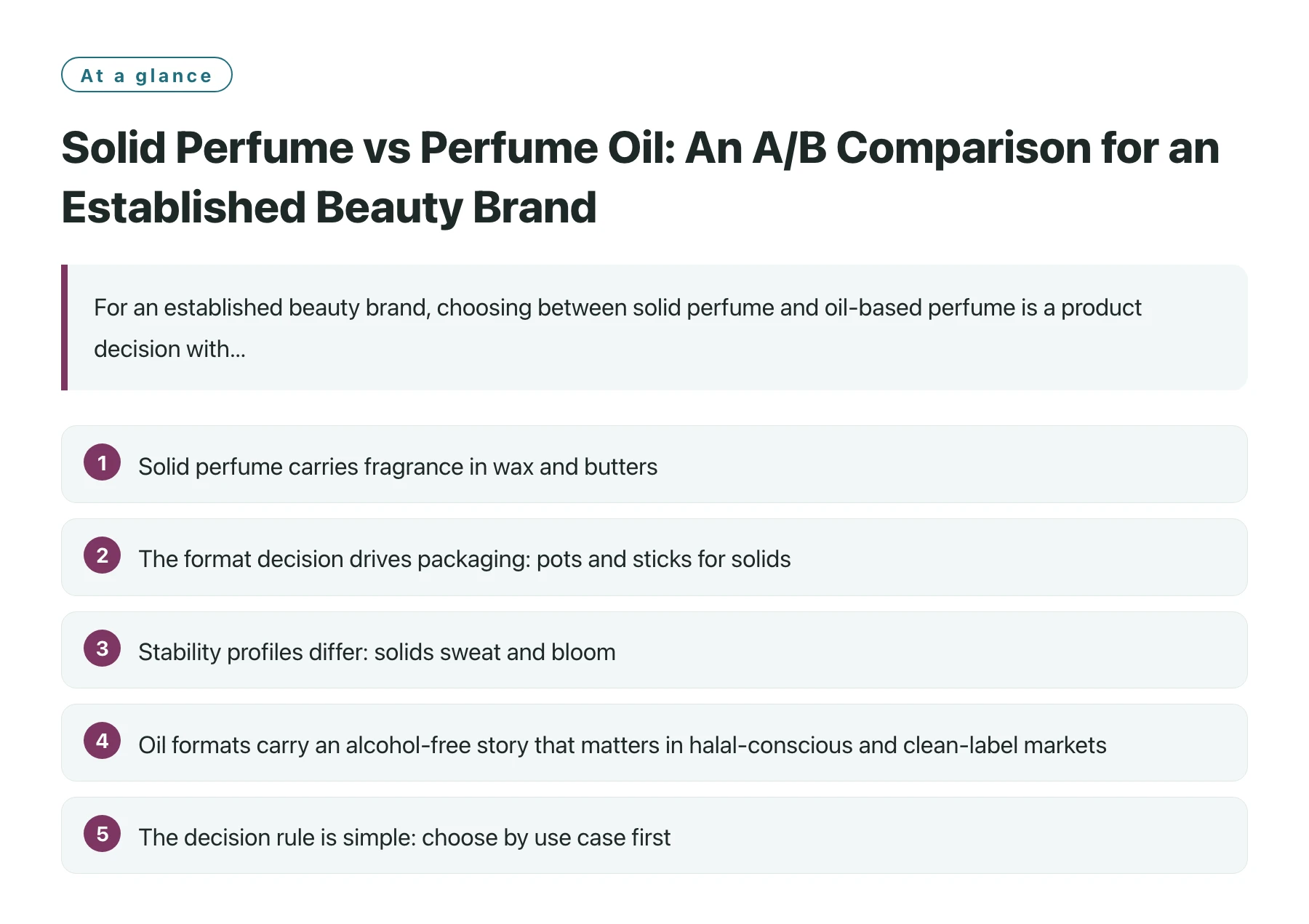
Key takeawaysSolid perfume carries fragrance in wax and butters, so it projects softly and lasts at skin level; oil-based perfume carries fragrance in carrier oil and projects more for the same dosage. · The format decision drives packaging: pots and sticks for solids, roll-ons and droppers for oils, and the packaging choice is half the formula's behaviour. · Stability profiles differ: solids sweat and bloom; oils oxidise and drift in viscosity, so the QC programme must be format-specific. · Oil formats carry an alcohol-free story that matters in halal-conscious and clean-label markets, which is a positioning advantage, not just a formulation change. · The decision rule is simple: choose by use case first, projection second, and let the range, not the novelty, pick the format. · Both formats are well-trodden production routes, and a manufacturer that already runs both can still tell you which one it is better at.
The shortest way to describe the trade-off: solid perfume is a product people carry, oil perfume is a product people wear. The first is chosen for portability, gifting and the ritual of application; the second for projection, layering and the precision of a drop or a roller.
What follows is the comparison a product developer would actually want, with the decision rule at the end.
The formats, side by side
| Attribute | Solid perfume | Oil-based perfume |
|---|---|---|
| Carrier | Wax and butters, e.g. beeswax, candelilla, shea | Carrier oils, e.g. jojoba, squalane, fractionated coconut |
| Projection | Soft, close to skin | Stronger for the same fragrance dosage |
| Longevity | Skin-level, several hours typical | Depends on the oil and dosage; generally durable |
| Application | Finger or stick | Roller, dropper or fine spray |
| Travel | No liquid restriction | Counts as a liquid in carry-on |
| Key stability risks | Sweating, blooming, hardness drift | Rancidity, oxidation, viscosity drift |
| Alcohol-free story | Yes, by construction | Yes, by construction |
| Best retail fit | Gifting sets, handbag formats, refills | Layering lines, halal-friendly ranges, scent bars |
Read the final row first. Both formats are alcohol-free, so the honest differentiators are use case and projection, and those are range decisions.
What the physics actually do
Perfume describes a family of formats, not one material, and the carrier changes how the scent reaches the nose [1]. In a solid, the fragrance sits in a wax matrix and releases slowly as it warms against skin, which is why solids smell closer and longer at skin level. In an oil, the fragrance is already at full concentration in the carrier, so the same accord projects further and faster.
That difference matters more on the skin than on the bench. An established brand launching its first solid or oil version of an existing scent should expect the character to shift, because the carrier changes the evaporation curve of every note. It is development work, and the pilot is where the final dosage gets found.
This is also why the brief usually lands with a manufacturer that adapts and develops scents rather than a filler of finished concentrate: adapting an existing accord into a new carrier is exactly the kind of project a manufacturer that builds custom scents is asked to solve.
The claim both formats share
Alcohol-free is the headline claim both formats can make, and it is the reason the two formats are often discussed together even though they are built differently. Fragrance safety is managed through the IFRA system and its safe-use framework, and an alcohol-free label does not change the compliance obligation; the same standards apply to the concentrate in both carriers [2].
Packaging is half the formula
The package is not a wrapper; it is part of the product. A solid pot controls how much air reaches the wax, a stick controls the application surface, and a roll-on controls how much oil lands on skin per pass. The same concentrate can smell different through a roller than through a dropper, and the fill equipment, tolerance and decoration choices all follow from the format decision.
For brands that want the scent and the format to evolve together across seasons, the conversation is best held with a partner that develops and fills both routes rather than one. Xuelei Cosmetics is one example of a house whose range spans classic sprays alongside newer formats, which makes the A/B discussion concrete instead of theoretical: the formats already coexist internally.
The refill angle
Solids in refillable pots and oils in refillable rollers are among the easiest refill formats in the fragrance category, and refillability has become a maintained product expectation rather than a niche feature. A brand that puts the refill in the brief from day one keeps the option open without redesigning the package later.
The decision rule that ends most meetings: if the product lives in a handbag or a gifting set, choose solid; if it lives on skin for an evening or in a scent-layering ritual, choose oil. Both are defensible; the range that tries to be both in one SKU is the one that explains itself poorly to its own customers.
Sources
- Wikipedia: Perfume —— An encyclopaedic overview of perfume covering definitions, history, the note structure of a fragrance and concentration terminology (background reference only).
- IFRA: Safe Use and Fragrance Science —— IFRA's explanation of how fragrance materials are scientifically assessed for safe use and how those conclusions are applied by the industry.
Frequently asked questions
Which format lasts longer on skin, solid or oil?
At skin level, both can last hours, but they last differently: solids release slowly from the wax matrix and stay close, while oils deliver a higher dose at application that fades with the oil's own evaporation. Judge longevity on your own skin chemistry in a pilot, not on aisle claims.
Can the same fragrance formula work as both a solid and an oil?
The concentrate can often be shared as a starting point, but the finished products are redeveloped, because waxes and carrier oils interact with the notes differently and change the evaporation curve. Minor reformulation is the norm, not the exception.
Is perfume oil stronger than solid perfume?
For the same fragrance dosage, oil projects more, because the carrier releases the scent faster than a wax matrix. Perceived strength also depends on application, so a heavy-handed solid can out-smell a light roller in practice.
Do solid and oil formats need different QC?
Yes. Solids are monitored for sweating, blooming and hardness; oils for rancidity, oxidation and viscosity. The regulatory documentation is similar, since both are cosmetics and both follow the same fragrance safety standards.
Which format should a beauty brand launch first?
The one that fits the retail channel: solids for gifting and travel-led retailers, oils for scent bars, layering lines and halal-friendly ranges. Launching the format your existing distribution already sells shortens the learning curve for everyone involved.