
Why choose used floor scrubbers instead of buying new cleaning equipment?
Imagine using the budget for a compact car to buy a reliable freight truck. This is precisely the capital efficiency revolution that choosing a second-hand floor scrubber can bring. From a financial perspective, the most direct attraction lies in the significant reduction of initial investment. A brand-new driving floor scrubber originally priced at 50,000 yuan may have a market circulation price of only 18,000 to 25,000 yuan after 2 to 3 years of standardized use. This means that your initial capital expenditure is immediately reduced by 50% to 65%. For start-ups or budget-sensitive projects, the release of this cash flow is crucial. It can reduce the proportion of equipment procurement costs in the total budget from 15% to within 7%, thereby allowing more resources to be invested in core business growth. A survey of medium-sized manufacturing enterprises shows that over 40% of them will give priority to evaluating certified second-hand options when purchasing professional cleaning equipment for the first time. As a result, the average payback period can be shortened to within 10 months, while the payback period for purchasing brand-new equipment is usually over 24 months. Understanding why choose used floor scrubbers is essentially a shrewd financial strategy for quickly converting fixed assets into productive efficiency.
However, the reduction in cost by no means implies a compromise in performance. The average design life of modern industrial equipment generally exceeds 10,000 working hours. A second-hand piece of equipment that has been in use for about 3,000 hours is in the "golden age" of its performance cycle, and the reliability deviation rate from that of a new machine is usually controlled within 5%. The key lies in choosing the target that has undergone strict technical assessment: checking whether the cumulative operating time of its motor is less than 4,000 hours, whether the battery cycle is within 500 times (the remaining capacity still retains more than 80% of the claimed value), and the maintenance records of key components such as water-absorbing motors and brush plate motors. Many well-known brands such as Nilfisk or K? rcher's certified second-hand equipment offers a core component warranty of up to 12 months. The failure rate statistics show that the difference from new models is less than 3 percentage points. In 2022, a logistics hub in South China purchased a bulk of 8 refurbished riding floor scrubbers, saving 120,000 yuan per unit price. Under high-intensity use for 16 hours a day, both their cleaning efficiency (over 5,000 square meters per hour) and the interval between faults fully met the operational standards. This confirms that second-hand equipment that has undergone professional remanufacturing is fully capable of handling harsh industrial scenarios.
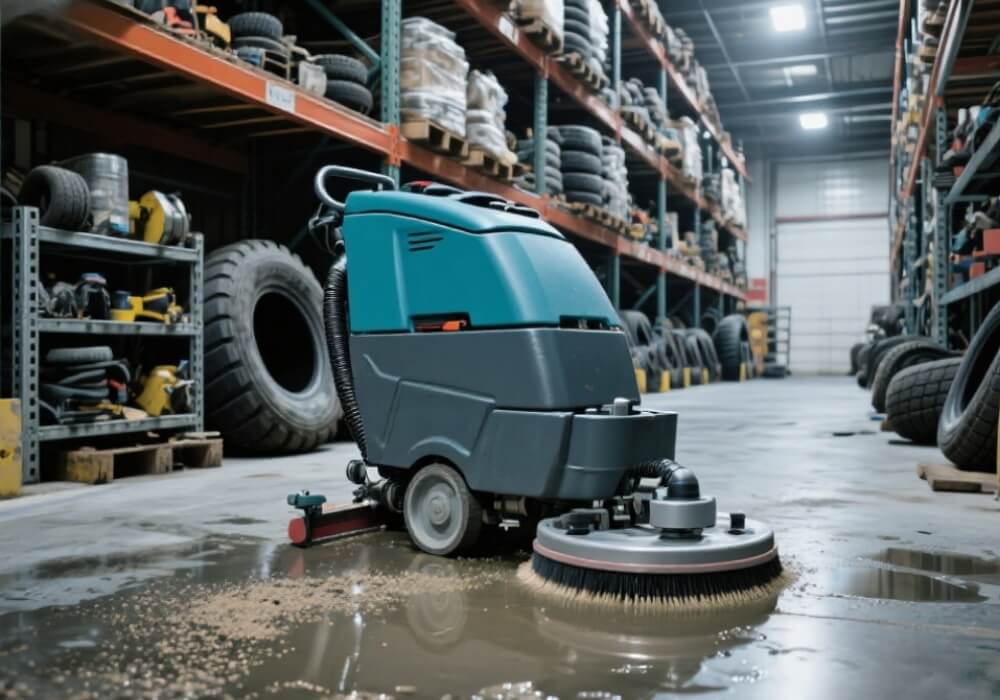 Today, with supply chain fluctuations becoming the new normal, choosing second-hand equipment can still significantly enhance the certainty and speed of procurement. Global events, such as the chip shortage caused by the COVID-19 pandemic, have extended the delivery cycle of some brands' new equipment from 8 weeks to over 30 weeks. This uncertainty will directly impact the operational continuity of enterprises. The on-hand delivery rate of second-hand equipment usually exceeds 90%, and the cycle from decision-making to deployment can be compressed to within one week. This is particularly applicable to dealing with sudden expansion demands. For instance, when a food processing plant received a short-term large order for a period of six months, it immediately purchased two floor scrubbers through the second-hand market channel at a price 40% lower than the budget, quickly meeting the cleaning needs during the capacity rampup period and avoiding the potential loss of over one million yuan in monthly output value due to waiting for new equipment. This agile asset allocation strategy is part of an enterprise's risk management and supply chain resilience.
Finally, from the perspective of life cycle cost and sustainability, why choose used floor scrubbers is also a visionary decision. The carbon footprint assessment of the manufacturing industry shows that over 70% of the carbon emissions of a piece of equipment occur during the raw material extraction and manufacturing stages. Choosing second-hand equipment is equivalent to maximizing the environmental cost-effectiveness that has already been generated, directly reducing the exploitation of new resources and energy consumption. It is a typical practice of a circular economy. Financially, you also need to calculate the total cost of ownership: including the estimated annual maintenance cost (approximately 8% to 12% of the residual value of the equipment), the cost of replacing consumable parts, and possible energy consumption. The comprehensive operating cost curve of a well-maintained second-hand device over the following five years may highly overlap with that of a new device. However, due to the huge price difference in the initial investment, its total cost of ownership advantage remains significant. Therefore, regarding the choice of a two-hand floor scrubber as a strategic purchasing behavior, which balances immediate financial pressure, predictable performance output, rapid deployment capabilities, and the increasingly important environmental responsibility, is a manifestation of a shrewd buyer's long-term perspective.
Today, with supply chain fluctuations becoming the new normal, choosing second-hand equipment can still significantly enhance the certainty and speed of procurement. Global events, such as the chip shortage caused by the COVID-19 pandemic, have extended the delivery cycle of some brands' new equipment from 8 weeks to over 30 weeks. This uncertainty will directly impact the operational continuity of enterprises. The on-hand delivery rate of second-hand equipment usually exceeds 90%, and the cycle from decision-making to deployment can be compressed to within one week. This is particularly applicable to dealing with sudden expansion demands. For instance, when a food processing plant received a short-term large order for a period of six months, it immediately purchased two floor scrubbers through the second-hand market channel at a price 40% lower than the budget, quickly meeting the cleaning needs during the capacity rampup period and avoiding the potential loss of over one million yuan in monthly output value due to waiting for new equipment. This agile asset allocation strategy is part of an enterprise's risk management and supply chain resilience.
Finally, from the perspective of life cycle cost and sustainability, why choose used floor scrubbers is also a visionary decision. The carbon footprint assessment of the manufacturing industry shows that over 70% of the carbon emissions of a piece of equipment occur during the raw material extraction and manufacturing stages. Choosing second-hand equipment is equivalent to maximizing the environmental cost-effectiveness that has already been generated, directly reducing the exploitation of new resources and energy consumption. It is a typical practice of a circular economy. Financially, you also need to calculate the total cost of ownership: including the estimated annual maintenance cost (approximately 8% to 12% of the residual value of the equipment), the cost of replacing consumable parts, and possible energy consumption. The comprehensive operating cost curve of a well-maintained second-hand device over the following five years may highly overlap with that of a new device. However, due to the huge price difference in the initial investment, its total cost of ownership advantage remains significant. Therefore, regarding the choice of a two-hand floor scrubber as a strategic purchasing behavior, which balances immediate financial pressure, predictable performance output, rapid deployment capabilities, and the increasingly important environmental responsibility, is a manifestation of a shrewd buyer's long-term perspective.
Today, with supply chain fluctuations becoming the new normal, choosing second-hand equipment can still significantly enhance the certainty and speed of procurement. Global events, such as the chip shortage caused by the COVID-19 pandemic, have extended the delivery cycle of some brands' new equipment from 8 weeks to over 30 weeks. This uncertainty will directly impact the operational continuity of enterprises. The on-hand delivery rate of second-hand equipment usually exceeds 90%, and the cycle from decision-making to deployment can be compressed to within one week. This is particularly applicable to dealing with sudden expansion demands. For instance, when a food processing plant received a short-term large order for a period of six months, it immediately purchased two floor scrubbers through the second-hand market channel at a price 40% lower than the budget, quickly meeting the cleaning needs during the capacity rampup period and avoiding the potential loss of over one million yuan in monthly output value due to waiting for new equipment. This agile asset allocation strategy is part of an enterprise's risk management and supply chain resilience.
Finally, from the perspective of life cycle cost and sustainability, why choose used floor scrubbers is also a visionary decision. The carbon footprint assessment of the manufacturing industry shows that over 70% of the carbon emissions of a piece of equipment occur during the raw material extraction and manufacturing stages. Choosing second-hand equipment is equivalent to maximizing the environmental cost-effectiveness that has already been generated, directly reducing the exploitation of new resources and energy consumption. It is a typical practice of a circular economy. Financially, you also need to calculate the total cost of ownership: including the estimated annual maintenance cost (approximately 8% to 12% of the residual value of the equipment), the cost of replacing consumable parts, and possible energy consumption. The comprehensive operating cost curve of a well-maintained second-hand device over the following five years may highly overlap with that of a new device. However, due to the huge price difference in the initial investment, its total cost of ownership advantage remains significant. Therefore, regarding the choice of a two-hand floor scrubber as a strategic purchasing behavior, which balances immediate financial pressure, predictable performance output, rapid deployment capabilities, and the increasingly important environmental responsibility, is a manifestation of a shrewd buyer's long-term perspective.